


Why Tile Choices Are Defining the Luxury Bathroom Right Now
For a long time, bathroom tiles were treated as a fairly safe, functional decision. White, perhaps with a single accent colour, chosen mainly for practicality rather than personality. That era has well and truly passed. Bathrooms are now treated with the same level of design ambition as kitchens and living rooms, and tiles sit right at the heart of that shift.
What is fuelling the change?
- Homeowners increasingly view the bathroom as a genuine wellness space rather than a purely functional room, and the material choices reflect that elevated ambition
- Manufacturing advances mean porcelain tile design UK options can now convincingly replicate natural stone, fabric, and even plaster finishes at a fraction of the cost and maintenance
- Social media has given everyone an education in what a truly considered bathroom looks like, and expectations have risen sharply as a result
- A beautifully tiled bathroom adds genuine value to a property, making it as much a financial decision as a design one
- There is a growing appreciation for materials with genuine texture and tactile quality, rather than the flat, uniform surfaces that dominated the previous decade
The result is a real and lasting shift in luxury bathroom tile trends UK homeowners and designers are embracing across every type of project, from compact en-suites to sprawling family bathrooms.
Natural Stone Surfaces: The Foundation of Genuine Luxury
If there is one category of material that defines luxury more completely than any other, it is natural stone. Stone bathroom surfaces UK homeowners are installing bring something that no engineered alternative can fully replicate: genuine, one-of-a-kind variation, formed over millions of years and entirely unique to your bathroom alone.
The most popular natural stone options each bring their own distinct character:
|
Stone Type |
Visual Character |
Best Application |
Maintenance Level |
|
|
Marble |
Luminous, veined, classically elegant |
Feature walls, vanity tops, statement floors |
Requires regular sealing |
|
|
Travertine |
Warm, earthy, naturally textured |
Wellness and spa-style bathrooms |
Moderate, benefits from sealing |
|
|
Limestone |
Soft, matte, deeply calming |
Floors and walls in understated schemes |
Moderate, benefits from sealing |
|
|
Slate |
Dark, moody, organic |
Feature walls and shower areas |
Low, naturally dense and durable |
|
|
Granite |
Speckled, robust, traditional |
Vanity tops and high-traffic floors |
Low, very durable |
The key to working with natural stone successfully is understanding that its beauty comes from its imperfection. Variation in veining, subtle colour shifts across the same batch, and natural pitting on travertine are not flaws to be minimised. They are precisely what makes the material feel genuinely luxurious rather than mass produced.
Marble Bathroom Tiles: The Gold Standard of Elegance
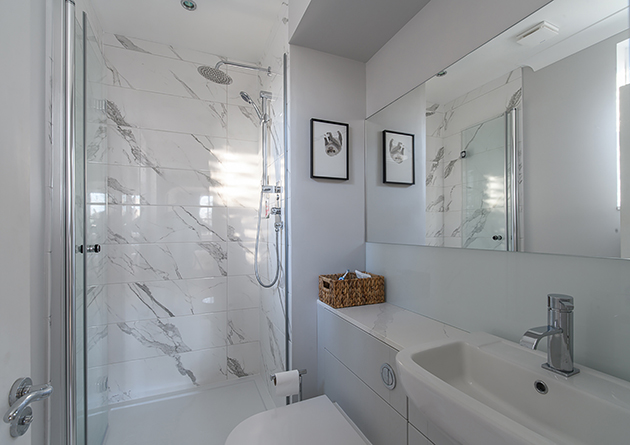
Within the world of natural stone, marble occupies a category entirely its own. Marble bathroom tiles UK homeowners choose are almost always selected for one reason above all others: nothing else creates quite the same sense of quiet, timeless luxury.
A few considerations worth understanding before committing to marble:
- Honed versus polished finish matters enormously. A honed, matte finish is significantly less slippery underfoot and tends to suit contemporary bathroom schemes beautifully. A polished finish reflects more light and feels more traditionally glamorous, but requires more caution on floors
- Book-matched panels create genuine drama. Two adjoining slabs cut from the same block and mirrored across a join create a striking, symmetrical veining pattern that is one of the most impressive effects achievable in bathroom design
- Marble pairs beautifully with warm metal finishes. Brushed brass and unlacquered bronze fittings against pale marble create a combination that feels properly considered rather than simply expensive
- Sealing is non-negotiable. Marble is porous and needs to be sealed properly during installation and resealed periodically to protect against staining, particularly from products like shampoo and shaving foam
For those drawn to the marble look but concerned about the maintenance commitment, porcelain alternatives have become remarkably convincing, which brings us neatly to the next major trend shaping bathrooms today.
Porcelain Tile Design: Beauty Without the Compromise
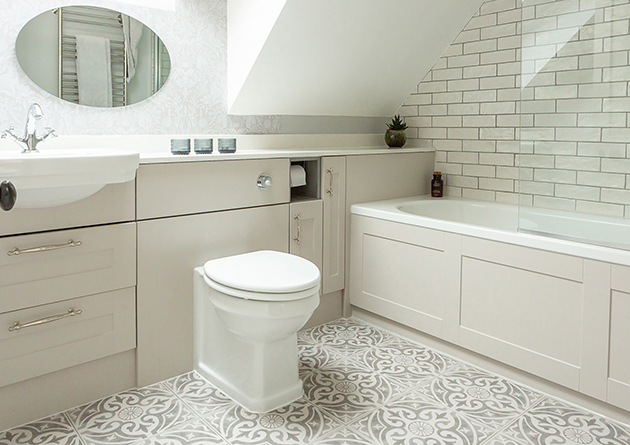
Porcelain tile design UK manufacturers are producing right now has reached a level of sophistication that genuinely surprises people who have not looked at the category in a few years. Digital printing technology has advanced to the point where high-quality porcelain can replicate marble veining, travertine texture, and even fabric weaves with extraordinary accuracy.
The practical case for porcelain is compelling:
- No sealing required, ever. Porcelain is essentially non-porous, which means it resists staining completely without any ongoing maintenance
- Exceptional durability. Highly resistant to scratching, chipping, and wear, making it ideal for busy family bathrooms
- Large format slabs available. Porcelain can be manufactured in genuinely enormous sheets, allowing for the same seamless, minimal-grout aesthetic that natural stone slabs achieve, often at a significantly lower cost
- Consistent, predictable results. Unlike natural stone, what you see in the showroom is precisely what you get installed, with no variation between batches to factor into your planning
Many of the most striking bathrooms we design at Sticks & Stones now feature porcelain rather than natural stone, simply because the practicality and predictability make it the smarter choice without meaningfully compromising on visual impact. Have a look at our bathroom design and installation service to see some of the results we have achieved using premium porcelain across recent projects.
Textured Tiles: Bringing Depth into the Bathroom
If natural stone and convincing porcelain represent one major shift in bathroom design, texture represents the other. Textured bathroom tiles UK designers are specifying right now move bathroom surfaces away from flat, uniform planes and towards something with genuine dimension and tactile interest.
The most popular textured tile styles worth knowing about:
- Fluted and ribbed tiles create vertical grooves that add rhythm and a sense of height to a feature wall, and work particularly well behind a freestanding bath or as a shower backdrop
- Handmade-look ceramics, often produced using traditional zellige techniques, have natural variation in glaze and surface that gives a bespoke, artisan quality no machine-perfect tile can match
- 3D relief tiles are bolder and more sculptural, ideal as a single feature wall rather than across an entire room, where the effect is most striking against a simpler, calmer surrounding palette
- Limewash and plaster-effect finishes, including genuine Tadelakt, create an organic, tactile quality that feels closer to a sculpted surface than a traditional tiled wall
Here is a quick comparison of how the major textured tile categories differ in character and application:
|
Texture Type |
Visual Effect |
Ideal Placement |
Pairs Well With |
|
Fluted or ribbed |
Rhythmic, elegant, linear |
Feature wall behind bath |
Warm metal fittings, marble |
|
Zellige or handmade ceramic |
Artisan, varied, characterful |
Splashback, shower wall |
Natural wood, earthy tones |
|
3D relief |
Bold, sculptural, dramatic |
Single statement wall |
Minimalist surrounding palette |
|
Tadelakt or limewash plaster |
Organic, seamless, soft |
Full shower enclosure or feature wall |
Natural stone, soft lighting |
For those drawn to the plaster-effect look, our Tadelakt plastering service creates a genuinely waterproof, seamless finish that delivers exactly this aesthetic with real craftsmanship behind it.
How to Bring These Trends Together Successfully
The bathrooms generating the most genuine admiration right now rarely rely on a single material or trend in isolation. They combine natural stone, textured surfaces, and premium porcelain thoughtfully, allowing each material to do the job it does best.
A few principles worth following as you plan your own scheme:
- Choose one material to lead. Whether that is a marble feature wall, a textured shower surround, or a striking porcelain floor, decide which element should draw the eye first and let everything else support it
- Balance texture with calm. A heavily textured feature wall works best against simpler, flatter surfaces elsewhere in the room. Too much texture competing for attention can feel busy rather than luxurious
- Consider the floor and walls as a connected story. They do not need to match exactly, but they should feel like they belong to the same considered scheme rather than two unrelated decisions
- Think about light. Polished and glossy surfaces reflect light and suit darker or smaller bathrooms. Matte and textured surfaces absorb light and suit bathrooms that already have plenty of natural brightness
- Connect the bathroom to the rest of the home. If your bathroom flooring transitions from a hallway or landing, consider how the tile choice relates to whatever flooring runs through the rest of the house. Our wood flooring options are worth a look if you want to create a seamless material story from room to room
Browsing real, completed projects is one of the best ways to see how these principles play out. Take a look at the Sticks & Stones for examples of how natural stone, texture, and porcelain have been combined successfully in bathrooms across Hampton and the surrounding areas.
Working With Sticks & Stones on Your Tile Selection
Choosing tiles for a bathroom renovation involves a genuinely enormous range of options, and getting expert guidance early in the process makes an enormous difference to the final result. At Sticks & Stones, we have been helping homeowners across Hampton navigate exactly this decision since 1994.
Here is what working with us looks like in practice:
- A free home survey and consultation where we understand your bathroom, your household, and your vision before recommending anything
- Access to a curated showroom range spanning natural stone, premium porcelain, and handmade ceramics
- Full 3D design drawings so you can see precisely how your chosen tiles will look before any work begins
- Skilled, experienced installation handled entirely by our own trusted team
- Genuine aftercare once the project is finished, because that is simply how we operate
If your bathroom is ready for a genuine transformation built around beautiful, considered material choices, we would love to help. Get in touch with the Sticks & Stones team today and book your free consultation.
Frequently Asked Questions
Q: What are the most popular luxury bathroom tile trends right now?
Natural stone, particularly marble and travertine, remains hugely popular, alongside high-quality porcelain that convincingly replicates stone without the maintenance demands. Textured tiles, including fluted, ribbed, and handmade ceramic finishes, are also having a real moment, bringing genuine depth and character to bathroom walls.
Q: Is natural stone tile practical for a bathroom floor?
Yes, with the right preparation. A honed rather than polished finish is recommended for floors as it provides better slip resistance underfoot. Natural stone floors also need to be sealed properly during installation and resealed periodically to maintain their resistance to staining and water absorption.
Q: Are porcelain tiles a good alternative to real marble?
Absolutely. High quality porcelain has advanced to the point where it can replicate marble veining with remarkable accuracy, while offering significantly better practical performance. It requires no sealing, resists staining completely, and tends to be more cost effective than genuine marble, making it a brilliant choice for many homeowners.
Q: How do I avoid a textured tile feature wall looking too busy?
The key is balance. Pair a heavily textured wall with simpler, calmer surfaces elsewhere in the bathroom, such as a plain floor tile or understated cabinetry. Choosing a textured tile in a neutral tone rather than a bold colour also helps the texture itself become the focal point rather than competing with strong colour.
Q: How much does a luxury tile renovation typically cost for a bathroom?
Costs vary considerably depending on the materials chosen, the size of the bathroom, and the complexity of the design. Natural stone generally costs more than porcelain, and bespoke or handmade tiles sit at a premium compared to standard ranges. We provide detailed, transparent quotes at the consultation stage, so you have a clear picture before committing to anything.

